For a SaaS business, the first goal is to learn whether relevant questions produce accurate descriptions and useful references. Treat the measurement as an investigation that can inform content and product communication.
Distinguish a mention, a citation and a recommendation
A mention names the brand in the answer. A citation identifies a source, usually through a linked reference. A recommendation endorses or suggests the product for a stated need. These can overlap, but they are not interchangeable.
An answer might name RankZap while comparing reporting workflows, link to a general guide on its website and recommend a different product for a specific use case. Counting all three as an unqualified win would obscure what the answer says.
Read the passage, record the linked URL and preserve the context. If the response does not expose source information, label the citation evidence unavailable. Do not infer a link because the answer resembles your content.
Name the actual surface being checked
A consumer chatbot session, a provider API and a search engine result page can return different answers. A generic model response is not evidence of a Google AI Overview. Record the real source and retrieval method.
When a provider or method changes, annotate the series. The same question asked through a different system is a new measurement condition. Do not silently combine it with earlier results and present a continuous trend.
Build a small, useful prompt set
Start with questions that reflect the audience's decisions. For SEO software, a first set might cover reporting requirements, agency workflows, page auditing and software comparisons. Use natural questions that a buyer could plausibly ask.
| Intent | Illustrative prompt | What to examine |
|---|---|---|
| Learn | What belongs in an SEO report for a small agency? | Concepts and sources surfaced |
| Compare | How should an agency compare SEO reporting tools? | Selection criteria and named options |
| Select | Which tools support website audits and client reporting? | Fit and factual product descriptions |
| Verify | Does RankZap publish unapproved content? | Accuracy of a specific branded answer |
The prompts above are examples, not a claim that they have measured search volume. Branded verification belongs in its own group because the question already supplies the product name.
Keep a prompt register
Record the prompt ID, exact wording, intent, source, market, language and frequency. Also record why the question matters. This prevents the set from drifting toward prompts that make the brand look good while ignoring important buyer needs.
Keep a stable core for comparison. Add exploratory prompts separately. When a prompt is retired, preserve its history and the reason. A falling rate caused by adding difficult questions is not the same as a decline on the original set.
Record failures separately
A completed answer that does not mention the brand is an observation. A timeout is missing evidence. Combining both into “not visible” understates technical failures and makes the trend difficult to interpret.
For each scheduled run, retain attempted checks, completed usable answers, failures, mentions and citations. Define whether a mention and citation can both count for the same answer. They often can, so their rates need not sum to 100%.
Calculate a rate with an explicit denominator
Suppose a fictional run attempts 12 checks. Ten return usable answers and two fail. The brand appears in three usable answers, and two answers cite a page on its website.
The sample mention rate is 3 / 10 = 30%. The website citation rate is 2 / 10 = 20%. The completion rate is 10 / 12, approximately 83.3%. The failure count remains visible as two.
These numbers are illustrative. They do not represent RankZap's results or a universal definition of an AI visibility score. A tool may use another formula, which should be explained before the score is compared.
For a small sample, keep the counts next to the percentages. Moving from one mention to two can look dramatic as a relative change while still representing only one additional answer.
Investigate the pages that answers cite
Review the source page's purpose, factual clarity and evidence. Does it directly answer the question? Is its author or publisher identifiable? Does it contain information your site lacks, such as a worked example, methodology or current product limitation?
Use that review to improve your own material where it helps readers. Do not copy another publisher's answer or create invented independent endorsements. A useful response may be a clearer feature page, a corrected setup guide or a comparison with explicit selection criteria.
Improve the information people can verify
Make the product's identity, capabilities, availability and limitations consistent across its own pages. Give important features dedicated explanations where the reader needs them. Link guides to the relevant tool or workflow instead of leaving them isolated.
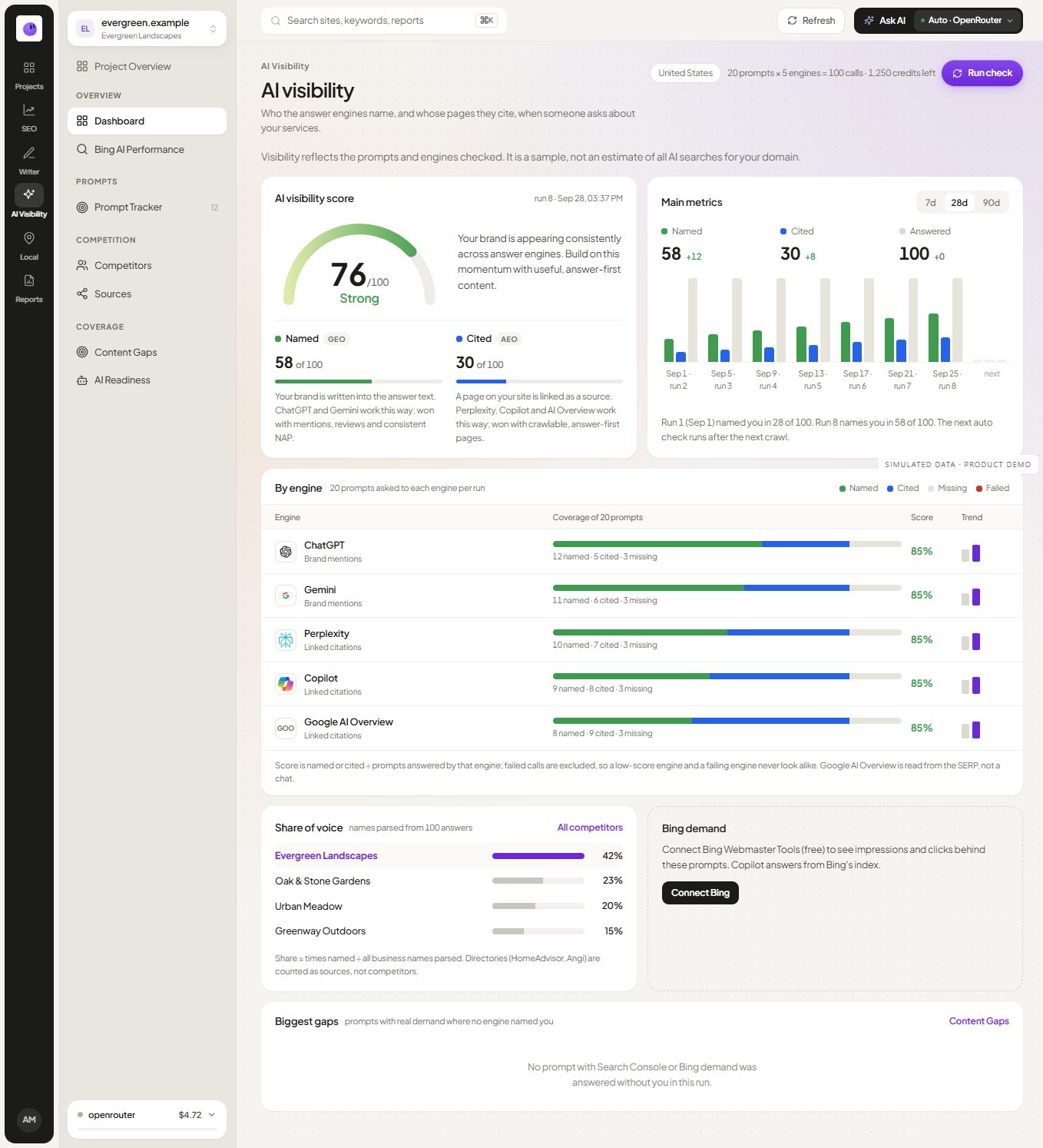
Add authentic evidence as it becomes available. A real experiment should describe the inputs, method and limitations. A case study should distinguish the work performed from measured outcomes. The simulated product screenshots in a demonstration can explain an interface, but they cannot substantiate customer growth.
Apply search fundamentals to AI search
Keep useful pages accessible, indexable where intended and understandable. Google's AI optimization guide frames optimization for its AI search experiences as part of SEO. It does not require a special AI text file, a prescribed passage length or a special schema format for visibility.
Use direct answers and clear headings because they help readers understand the content. Do not force every section into a fixed word count or add unsupported statistics to meet a citation formula.
Access policy should also match the specific system. Search retrieval and model training are different purposes; inspect current provider documentation before changing crawler rules. Allowing access is an eligibility consideration, not a promise of citation.
Report useful findings, not only a score
A monthly review can summarize the stable prompt set, completion rate, mentions, cited pages and material factual errors. Include a few representative answer excerpts only where permitted and useful. Record the run date and the source for every example.
Then choose the work. If answers repeatedly describe a retired feature, correct the available product information. If a valuable question lacks a useful answer on the site, prepare one with relevant evidence. If most checks fail, repair measurement before interpreting visibility.
Keep referral traffic and conversions as separate observations. A rise in citations does not automatically prove a rise in qualified customers. The SEO reporting guide provides a structure for explaining related measurements without claiming unsupported causation.
Separate access, observed answers and commercial outcomes
A useful measurement plan has three layers. First, inspect whether intended source pages can be reached. Second, record actual answer samples and their citations. Third, review attributable visits and verified business actions where measurement supports them. A pass at one layer does not establish a result at the next.
An access checker can reveal a blocked page, but cannot prove that an answer recommends your SaaS. An answer can cite your guide without sending a measurable visit. A referral visit can be real without becoming a qualified trial. Keep those observations separately labeled in the report.
Choose competitor and source comparisons carefully
Record named competitors only within the same completed answers and prompt set. Define whether your share metric counts answers, brand mentions or all named brands; the denominators produce different results. List cited source domains separately from product competitors because a publisher or directory can be a source without selling the same product.
Keep language and market stable for a comparison. An English US prompt and a German prompt about European suppliers can represent different questions even when they discuss the same product category. Use a separate series when the intended audience changes.
The prompt register provides editable fields for the exact wording, source, evidence and status. Complete the register before interpreting a trend.
Start with a repeatable first cycle
- Choose a defined audience and decision.
- Write a small prompt register with stable wording.
- Record actual sources and settings.
- Run the checks and preserve evidence.
- Separate failures, mentions, citations and recommendations.
- Select one factual or content improvement.
- Repeat the checks under comparable conditions.
How many prompts should I track?
Enough to cover the decisions you intend to study and can afford to review. A larger set with unclear intent or changing settings can be less informative than a smaller stable set. Explain its scope instead of claiming complete market coverage.
Will publishing more pages make AI systems recommend my SaaS?
Page count alone does not establish usefulness or independent recommendation. Publish when a page provides a distinct answer, functioning utility or credible evidence. Measure what happens without promising the result in advance.
Can a free check prove that my brand is invisible?
A limited check can show absence from a particular completed sample. It cannot establish absence from every question, user context or platform. Preserve that limit when reporting the result.
Explore this topic
 Simulated dataSimulated data