Service page example
Page purpose: explain landscape maintenance for a defined service area.
Draft: “Explore landscape maintenance for homes in Austin. Review the services, understand the visit process and request a quote for your property.”
This description identifies the service, audience and next step. Use the location only if the business actually serves it. Remove any claim about response time or pricing unless the page substantiates it.
Free tool example
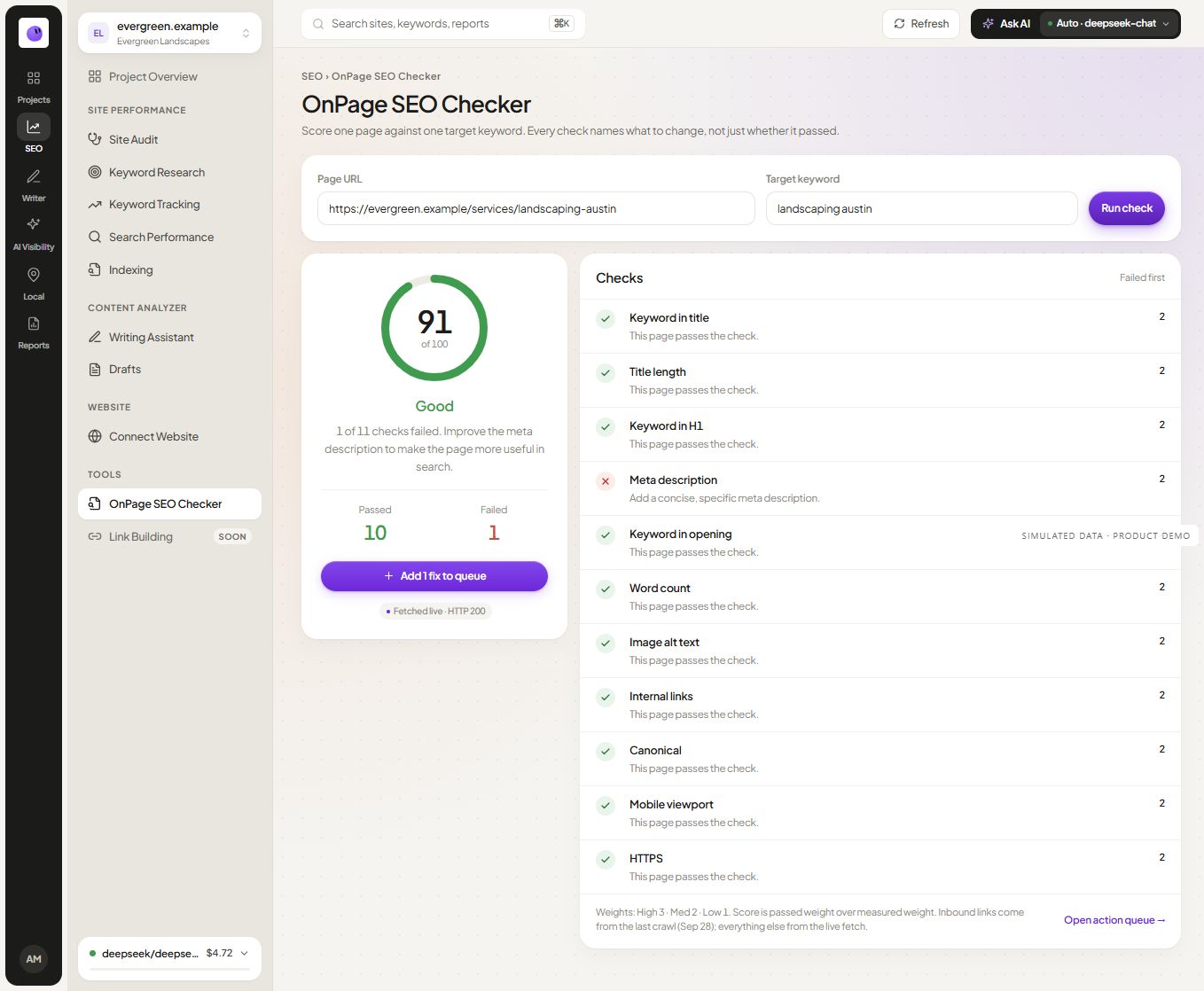
Page purpose: check a public URL and explain supported findings.
Draft: “Check a public page for supported SEO issues. Review the evidence behind each finding and choose the next improvement for your website.”
A tool page should describe the actual result. Do not call a one-page check a complete website audit, and do not advertise unlimited use if an enforced allowance applies.
Template example
Page purpose: provide a reusable reporting worksheet.
Draft: “Use an editable SEO report template to summarize search results, explain important changes and give clients a clear plan for the next month.”
The value is the resource and how it helps the reader. The page should contain a working download or usable copy, not only a signup form promising a future template.
Comparison example
Page purpose: help a buyer compare software for a specific workflow.
Draft: “Compare SEO reporting tools by data sources, branding, review controls and total cost. Use a practical worksheet to test your agency's requirements.”
This wording supports a fair comparison. It does not claim every product was tested or declare a universal winner without a methodology.
A repeatable writing method
Write the page's job in one sentence. Add the most useful differentiating detail, such as the audience, format or supported task. Include a natural next action when the page offers one.
Read the title and description together. Remove repeated wording that adds no information. Check that the description applies to this page and would not equally describe five unrelated pages.
Use preview width and character count as editing aids. Google can choose different snippet text, and its snippet documentation explains that descriptions are one possible source. No particular character count guarantees display.
Match the description to the intent, not just the keyword
A visitor searching for an example wants something to inspect. A visitor searching for a generator wants an input and editable output. A visitor comparing software wants selection criteria and evidence. The description should signal which task the page actually serves.
For an article explaining SEO audit scores, a useful draft is: “Learn what an SEO audit score measures, why tools disagree and how to use the findings to choose a practical next fix.” Sending that visitor to a signup-only screen would break the promise even if the phrase appears in the title.
Do not create separate pages solely for “AI,” “free” and “online” generator variants when the same functioning tool answers them. Describe the actual free scope and AI involvement on the canonical tool page.
Check the implementation
After saving the metadata, inspect the public output. Templates and plugins can overwrite a field or emit duplicate information. Confirm that the approved wording reaches the correct URL.
If the offer changes later, review the description again. An accurate short summary can become misleading when the service, price or free scope changes.
Use the meta description generator to prepare a draft when available, then check it against the page. The SEO checker can support a broader page review.
Should the target keyword appear in every description?
Use the phrase when it accurately identifies the topic and reads naturally. A description filled with variants is less useful than a clear summary of the page.
Should I use the same description for every product?
Distinct products should have descriptions that reflect their differences. For very similar variants, review the page and canonical strategy before producing many nearly identical snippets.