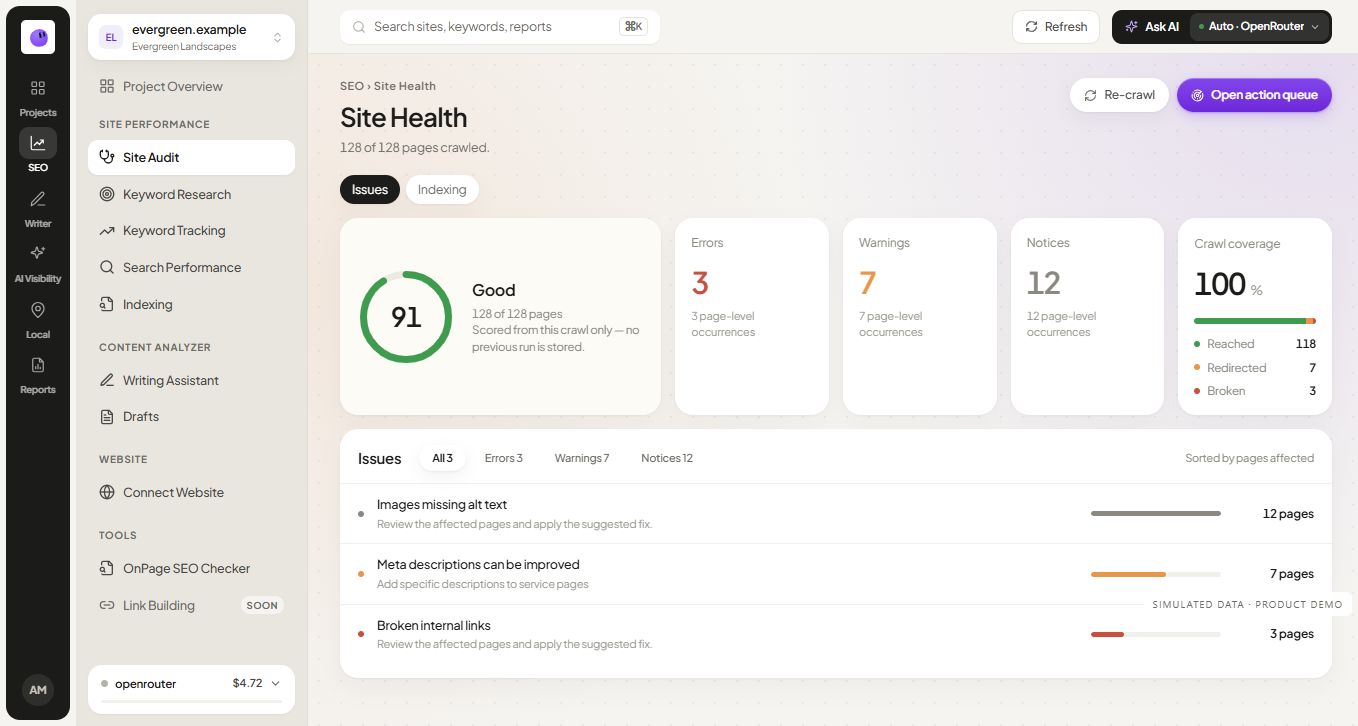
Use automation to find and organize observations. Use review to decide which observations represent real problems and what should change.
Retrieval is the first limit
A tool can inspect only what it successfully obtains. A timeout, blocked request or login wall changes the available evidence. A source-only check may differ from a rendered browser view. Keep retrieval status visible alongside the findings.
For an important page, compare the reported evidence with the live page. If the tool and browser disagree, investigate the environment before changing the site to satisfy the tool.
A rule is not the same as a diagnosis
Rules work well for clearly defined observations: a link resolves to a missing page, or the retrieved document contains a particular directive. The next conclusion requires context. A missing-page response may be correct for a deliberately removed resource. A noindex directive may be intentional.
The reviewer needs to know the intended behavior. Record it in the finding so an implementation agent does not blindly reverse a deliberate choice.
Content usefulness cannot be reduced to length
A short calculator page can solve a task that a long article cannot. A detailed service guide can still omit its most important limitation. Word counts and heading counts can prompt investigation, but they do not establish whether the reader received a useful answer.
Evaluate the page against the question it should answer. Check accuracy, examples, navigation and the next action. Add information because the reader needs it, not because a generic floor was missed.
Correlation is not a completed explanation
If a score rises and traffic rises in the same period, that does not isolate the score change as the cause. Demand, content, competition, tracking and other site changes can also vary.
Document what was changed and what was measured. When the cause is uncertain, propose an investigation and keep the report's wording proportionate to the evidence.
Make automation useful with a review loop
- Define the page set and crawl settings.
- Inspect failed or incomplete retrievals.
- Sample important findings on live pages.
- Group repeated findings by underlying cause.
- Assign a bounded change with a verification step.
- Rerun the relevant checks after deployment.
For a fictional 200-page service website, ten repeated navigation warnings may come from one component. Review that component and its affected templates. The right output is one well-scoped repair plus evidence, not ten disconnected rewrite tasks.
Know when another source is needed
Indexing questions need relevant search-engine evidence. Conversion questions need verified business measurement. Claims about a product need current product information. No single audit output should be treated as a substitute for all three.
Use the technical checklist to structure the review and the audit worksheet to record the findings. RankZap's SEO audit can support the repeatable part of that workflow.
Is manual review needed for every page?
Use representative checks for shared templates and inspect high-value or unusual cases directly. Expand the sample when the first checks reveal inconsistent behavior.
Should AI automatically rewrite every flagged page?
Only a confirmed content problem with a clear brief supports a rewrite. Review facts and the intended change before publication. An automated warning does not authorize an accurate replacement on its own.
Continue your workflow
Simulated data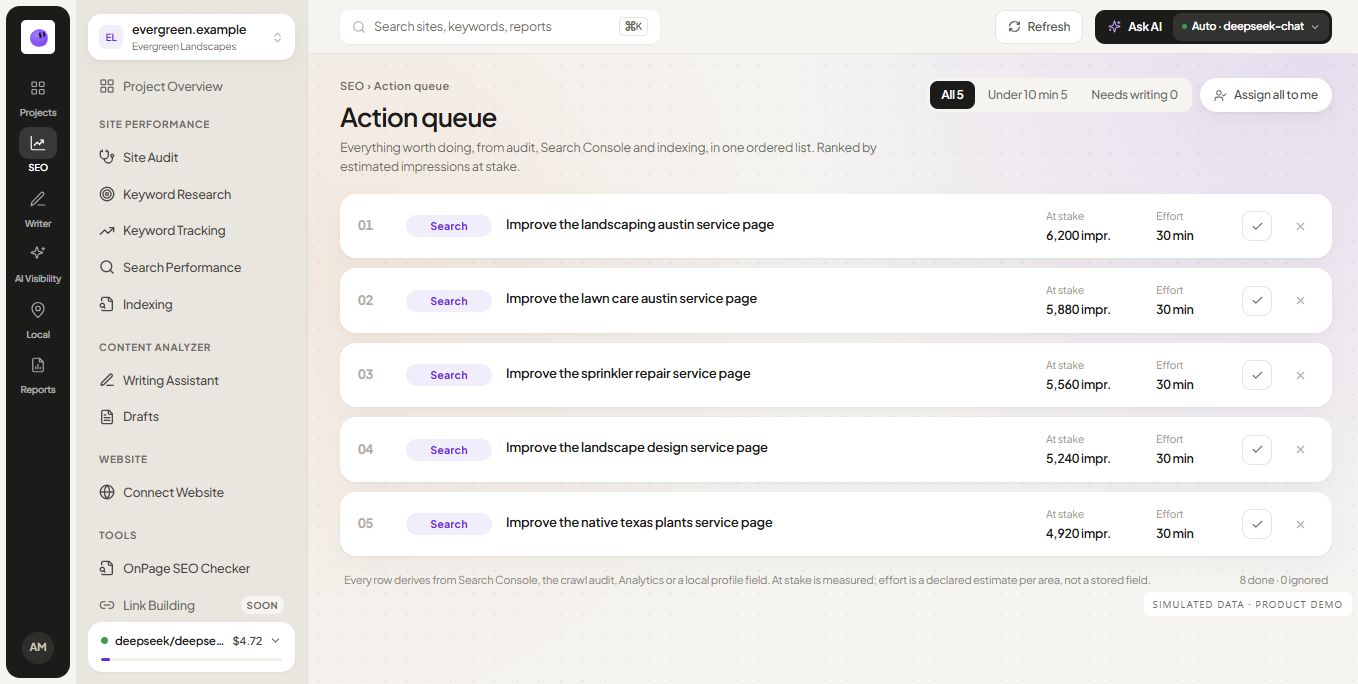 Simulated data