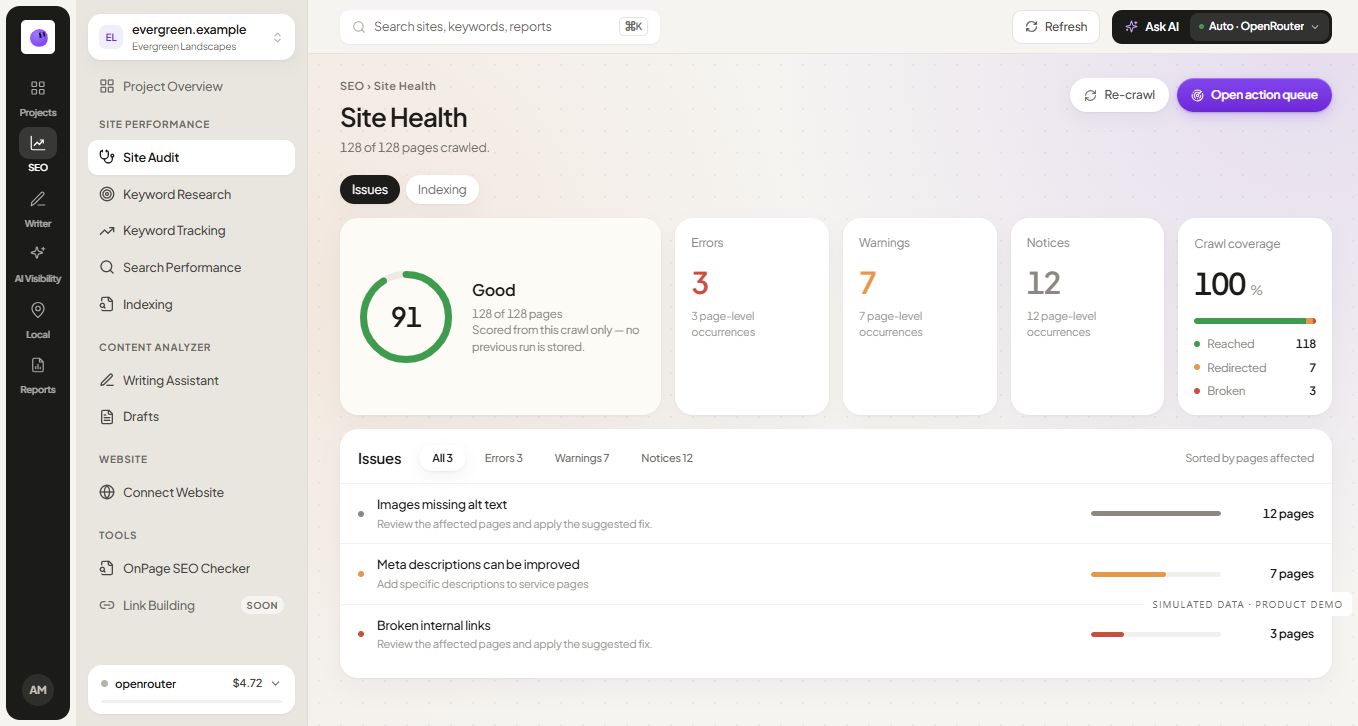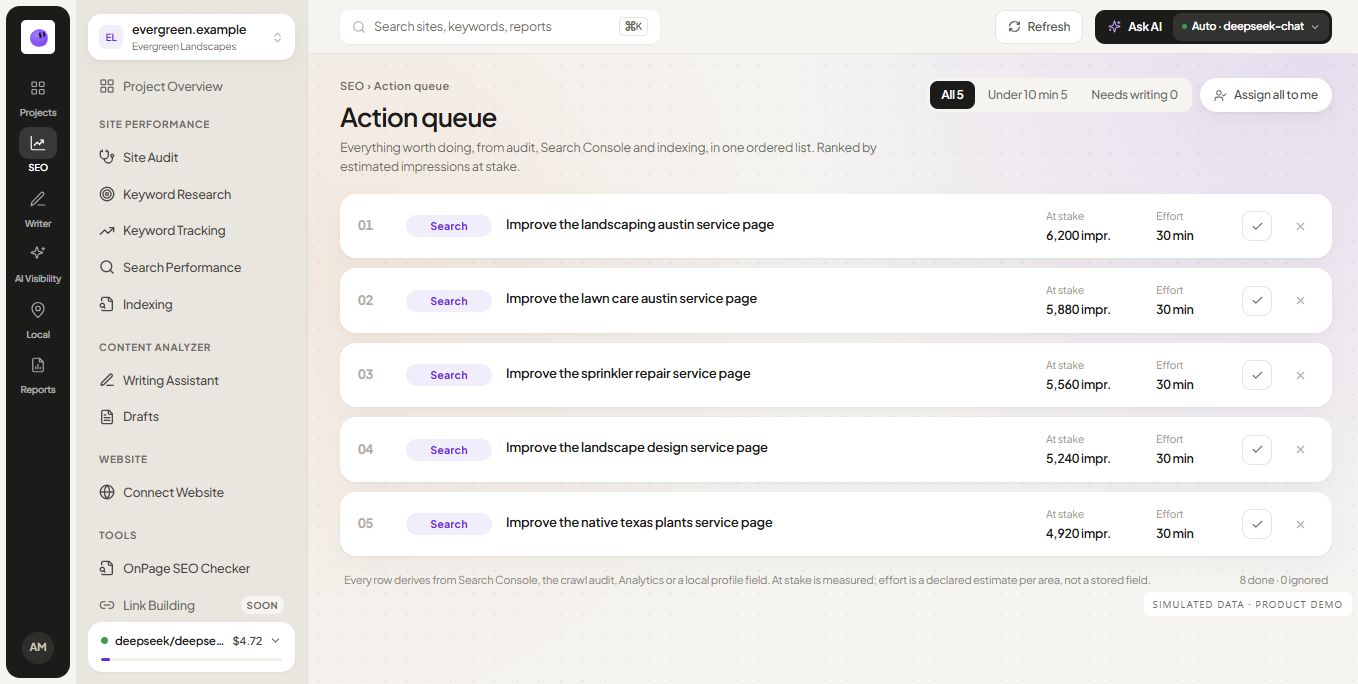
An audit can identify hundreds of observations. The implementation queue should describe the underlying work, not reproduce every row of the crawler output.
Start by separating three kinds of finding
Confirmed defect: the observed behavior contradicts the intended behavior. A published contact link reaches a removed page, for example.
Investigation: the observation could have several explanations. A decline in clicks needs context before a specific content change can be prescribed.
Intentional behavior: the site behaves as designed. An internal utility page excluded from indexing may belong here.
Keep these categories visible. Treating an investigation as a confirmed defect can lead to unnecessary changes, while treating missing data as a pass can hide important work.
Use impact, confidence and effort
Ask what would happen if the finding remained unresolved. Could it prevent a visitor from completing the main task? Does it affect discovery or access to a commercially important page? Is the proposed improvement based on evidence or a weak proxy?
Then ask how confidently the fix addresses the problem. A reproduced broken link supports a direct repair. A speculative rewrite intended to “improve relevance” needs a more precise diagnosis.
Finally, estimate implementation and verification effort. Include dependencies and regression risk. A small template change can have a large scope, so a quick edit may still need careful checking.
Group findings by root cause
If 300 pages share a wrong footer destination, create one task to fix the component and a verification plan for representative pages. Keep the affected URL list as evidence. Avoid assigning 300 separate edits unless the pages genuinely require individual work.
Conversely, do not group unrelated content problems just because they share a warning label. Three thin-looking pages may serve different tasks and need different decisions: expand one, merge another and retain a concise utility page.
A worked prioritization example
The following queue is fictional.
| Finding | Importance | Confidence | Effort | Order |
|---|---|---|---|---|
| Quote form fails on mobile | High-value action blocked | Reproduced | Moderate | First |
| New service template emits noindex unexpectedly | Important pages affected | Verified in output | Moderate | First |
| Footer points to a removed resource | Repeated navigation defect | Reproduced | Low | Next |
| Two descriptions use similar wording | Limited known consequence | Needs review | Low | Later |
| Audit score is below competitor's score | Consequence unestablished | Not comparable | Unknown | Investigate methodology |
This is an editorial prioritization method, not a Google ranking formula. Teams can use different labels while preserving the evidence behind the order.
Give the task an acceptance criterion
“Improve internal linking” is difficult to close. “Replace the removed guide destination in the resource component, verify the new link on three templates and confirm no old component links remain” is testable.
For a content task, define the reader question, the evidence to add and the page that should contain it. Avoid acceptance criteria based only on reaching a word count. A longer page can still omit the answer.
Record the owner and the dependency. If product information is missing, the first task is to obtain the information rather than generate confident prose around the gap.
Revisit priorities when evidence changes
A newly reproduced issue may move ahead of an earlier hypothesis. A planned migration may make a large content cleanup premature. Update the queue and explain the reason so the team can follow the decision.
Keep the audit worksheet with the project. Use the technical checklist for investigation and the reporting guide to explain completed work.
Should I fix all errors before warnings?
Read what the labels mean in the specific tool. Severity labels are useful starting points, but the business context and verified behavior determine the priority.
Is a quick win always the best first task?
No. A trivial improvement can be quick while a serious blocker remains unresolved. Use effort as one input alongside consequence and confidence.
Continue your workflow
Simulated data Simulated data