Define the location and the reporting question
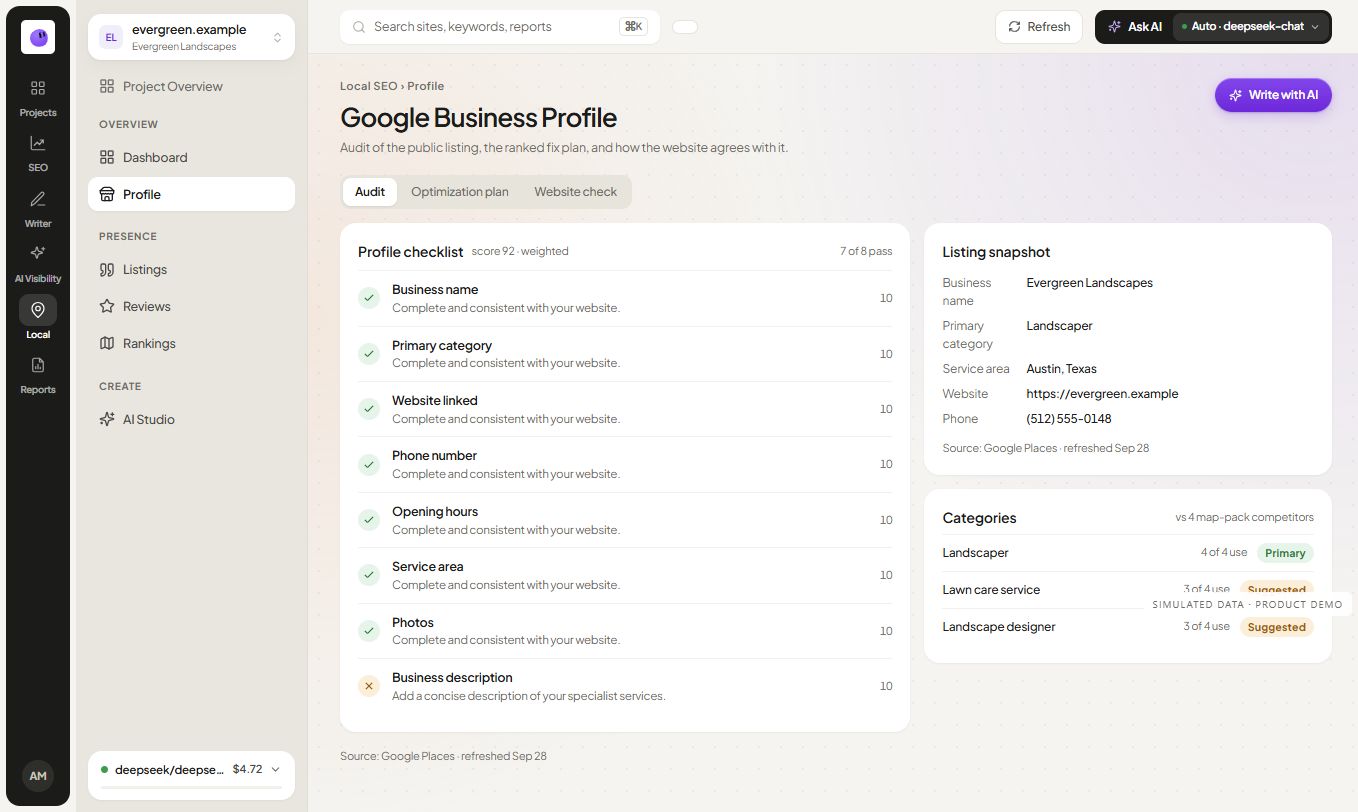
Start with the business, its website and the listing being measured. Record the location or service area, the business category and the services that matter to the report. A similarly named listing in another town is a different entity; a result for the wrong location cannot describe this business's progress.
Decide what the recipient needs to understand. An owner may want to know whether qualified enquiries changed. A local SEO specialist may need to investigate gaps in map coverage. These questions require different evidence, even when they concern the same business.
For a multi-location business, keep a separate record for each location. Aggregate only measures with compatible definitions and periods. An average across locations can hide a problem affecting one storefront or service area.
Keep the main sources distinct
| Source | What it can help explain | What it does not establish by itself |
|---|---|---|
| Public business listing | Visible identity, category, reviews and other returned public details | Private owner performance, verified calls or booked jobs |
| Geographic rank sample | Observed positions for a query across selected points | Every searcher's result or the number of potential customers |
| Search Console | Search clicks, impressions, queries and pages for an authorized property | All map interactions or completed offline sales |
| Google Analytics | Recorded website traffic and configured events | Unrecorded calls or an independently verified revenue figure |
| Enquiry or customer records | Qualified leads and outcomes when recorded consistently | Proof that SEO alone caused every outcome |
Use only sources you are authorized to access. Label their periods, filters and missing data. If a source is unavailable, report that limitation instead of inserting a zero.
Read a map grid as a sample
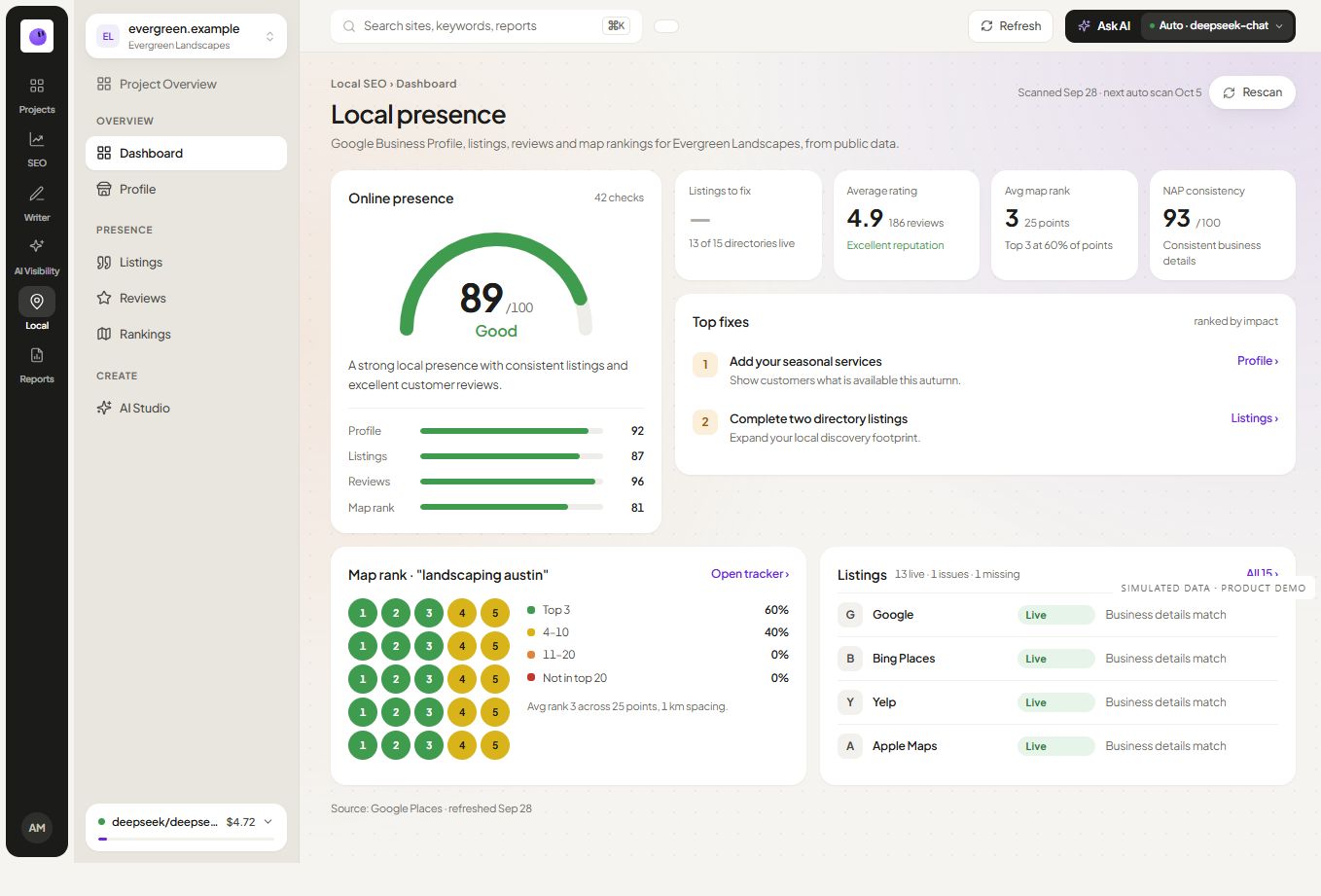
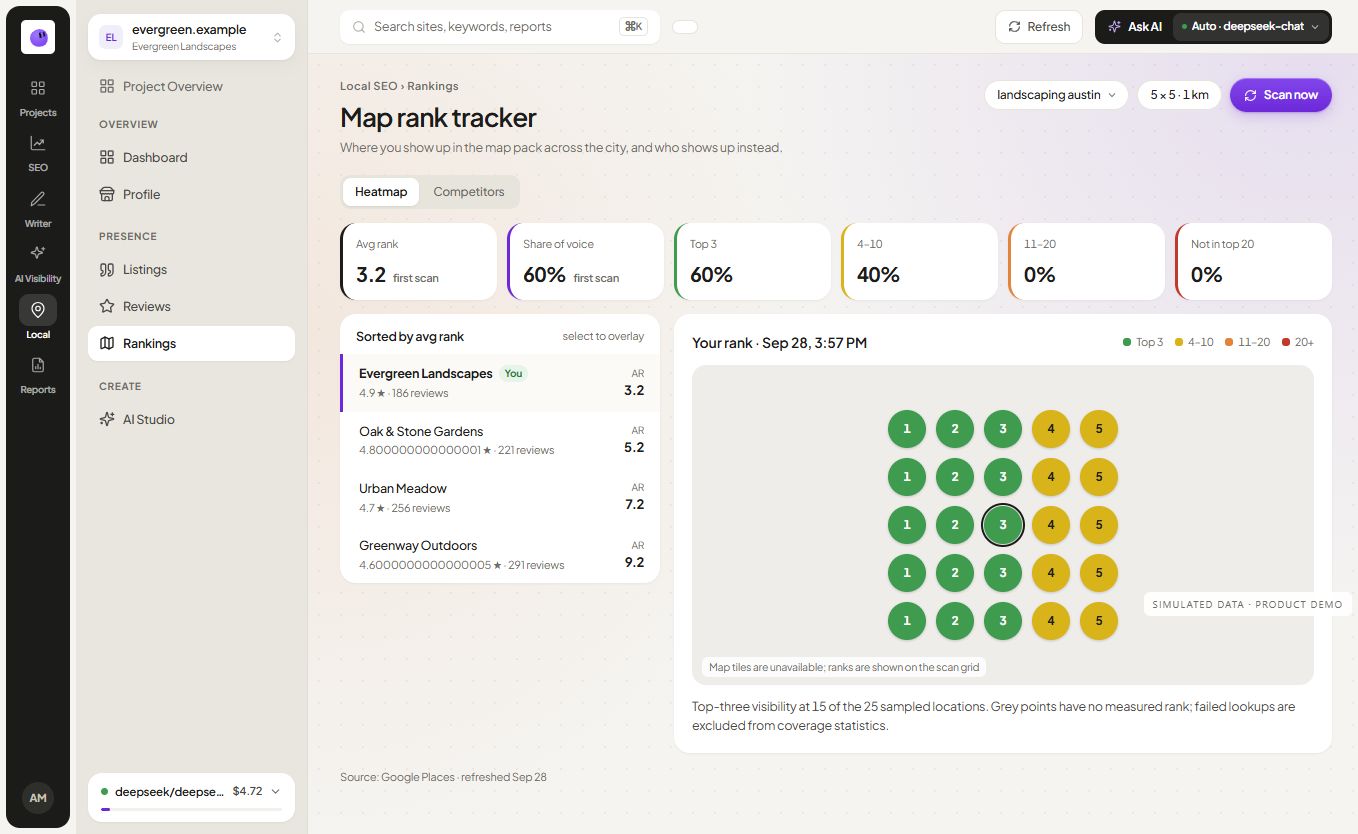
A geographic grid repeats a defined query at selected locations. Its value comes from the pattern: results may be stronger close to the business and different across the wider service area. Preserve the grid center, spacing, query, source and observation time before comparing runs.
Keep map results separate from ordinary organic website positions. Both may matter, but they describe different placements. A business listing's position is not interchangeable with its website's position.
Illustrative example: a run attempts 25 grid points, completes 20 and finds the business in the top three at eight completed points. Top-three coverage within the completed sample is 8 ÷ 20 = 40%. Completion is 20 ÷ 25 = 80%. The five failed points are not evidence that the business was absent.
Do not label that 40% as market share or the percentage of local customers who can find the business. It describes the selected query and completed sample only. Use the local rank-tracking workflow to understand the available project context.
Explain changes before recommending work
Compare equivalent runs. A changed query, grid size, center or observation source can make a chart move without establishing an underlying improvement. Record those changes with the report.
When the same measure changes under comparable settings, investigate likely explanations. A listing edit, a competitor change, a website update or ordinary result variation may be relevant. Present a hypothesis as a hypothesis until supporting evidence exists.
Choose an action that follows from the observation. If the business identity is inconsistent, verify the correct details and relevant source. If a service page attracts impressions but poorly explains the service, review that page. A low position at one distant point does not automatically justify creating another location page.
Use a concise report structure
- Scope: the business, location, source, period and question being addressed.
- Summary: the important observation, its business relevance and its limit.
- Evidence: comparable samples, source data and the affected page or listing.
- Completed work: actual changes, owners and dates.
- Next actions: a short prioritized list with responsibility and a verification step.
For a recurring client update, adapt the SEO report template. Keep local observations alongside the broader website results, with each source clearly labeled. The SEO reporting guide explains how to separate an observed change from a claim about its cause.
Match the report to the available product scope
RankZap's local workflow uses supported public listing information and local observations. Direct Google Business Profile account access is not currently enabled. Public listing checks should not be described as a connection to private owner performance data.
Read the Google Business Profile access status before planning a report around that connection. The local SEO reporting feature describes the reporting task, while the local workflow explains the sequence from identifying the location to reviewing observations.
Review before sharing
Confirm that every chart identifies the correct business and source. Check the dates, completed sample size and meaning of each percentage. Remove unsupported revenue claims and explain any gap in measurement.
Then ask whether the next action is specific enough for someone to carry out. “Improve local SEO” is too broad. “Verify the service category on the identified listing, record the change and repeat the same defined observation” gives the team a reviewable task.
Can a map grid prove that local SEO produced more leads?
A grid measures sampled visibility. Connect it with consistently recorded enquiries and relevant website events before discussing lead changes. Even then, consider other changes that may affect demand and conversion.
Should every location use the same report?
Use a consistent structure so comparisons are understandable, while retaining each location's identity, service area, available sources and business context. Do not copy another location's findings into the report.
What should happen when a source fails?
Identify the unavailable source, show which part of the report it affects and investigate the failure. Keep incomplete observations separate from genuine zero values and repeat the relevant check after access is restored.
Explore this topic
 Simulated dataSimulated data
 Simulated data
 Simulated data